

Why start with low-cost marketing strategies?
The cheapest way to make paid ads work is to find out what your customers respond to before you pay for reach. Low-cost marketing strategies such as founder Reels, community answers and small creator tests show you which messages, hooks and offers convert. Then influencer fees and Meta ad spend go behind proof, not guesses.
Many small businesses do the opposite. They pay an influencer, boost the post, and judge success by views. Views are cheap. Customers are not. Without a tested message, a low budget marketing plan burns money on attention that never turns into sales.
This guide covers six methods, ranked for a small budget, and shows how to feed the winners into Meta ads. One caution: "low cost" means low cash cost. Your time and production effort still cost something, so count them.
Low-cost marketing ideas for small businesses at a glance
Founder Reels and small creator tests give the fastest feedback for the least cash. The table ranks all six by practical fit for a small budget, not by a universal cost figure.
| Method | Cash cost | Speed of feedback | Best use |
|---|---|---|---|
| Founder and team Reels | Very low if made in-house | Days | Test hooks, demos and offers with new viewers |
| Niche communities | Little or none | Days to weeks | Learn customer language and answer real questions |
| Complementary-brand partnerships | Often none | Weeks | Borrow a trusted audience that already buys nearby |
| Customer content and referrals | Content costs or referral rewards | Weeks | Collect proof and reward actions that lead to sales |
| Small niche creators | Product, shipping, fees or commission | Weeks | Find creators and content worth turning into ads |
| Search-focused content | Writing or production time | Months | Build steady traffic from people with a question |
01Founder and team Reels
Short videos made by the people who know the product best are the cheapest test of what makes a stranger stop scrolling. A phone, good light and a clear point are enough.
Focus on buyer-intent formats rather than broad entertainment:
- Product demonstrations: show the product solving one problem in under 30 seconds.
- "How to choose" guides: walk through what a buyer should check before purchasing.
- Common mistakes: name the errors your customers make before they find you.
- Comparisons: your product against the usual alternative, stated fairly.
- Customer results: a before-and-after or a short testimonial, with permission.
Instagram's Trial Reels make this a cleaner experiment. A trial Reel goes to non-followers first and stays off your grid and your followers' feeds, so you can test a hook without tiring your audience. Instagram says insights arrive within 24 hours, and a strong trial can be shared to followers automatically after 72 hours (9to5Mac). Eligibility depends on account type and settings, so check it in your app.
Compare trial Reels with other trial Reels, not with normal posts. Non-follower reach is usually slower, so judge each test on saves, shares, profile visits and link clicks.
02Niche community participation
Answering questions where your buyers already gather costs nothing but time, and it hands you their exact words for ads later. Look for niche Facebook groups, subreddits, Discord servers, LinkedIn groups and industry forums.
- Read the rules first. Many communities ban promotion or allow links only on set days.
- Lead with a complete answer. Link to your product only when it genuinely fits the question and the rules allow it.
- Save the questions. Recurring questions become Reel scripts, FAQ entries and article topics.
- Note the wording. The phrases people use to describe their problem often make better ad headlines than anything written in a meeting.
Use one consistent profile so people can find you after a helpful answer. Track the traffic with a UTM-tagged link where links are permitted.
03Complementary-brand partnerships
Partnering with a business that serves your customer with a different product gives you a trusted audience for no media spend. A yoga-mat brand and a meal-prep service share buyers; neither competes with the other.
Formats that work on small budgets:
- Newsletter swaps: each brand features the other in one issue.
- Joint live sessions: a 30-minute Instagram Live or webinar on a shared customer problem.
- Bundles or co-branded offers: a discount for buying both products.
- Shared content: a collab post that appears on both profiles.
Pick partners with a similar audience size and price point so the exchange feels fair. Agree on the offer, the dates and how you will track results, such as separate discount codes, before anything goes live.
04Customer content and referrals
Your existing customers are the most believable marketers you have, and a referral program pays only when it produces a result. Ask happy customers to share a short demo, an unboxing or their honest experience.
- Ask at the right moment: after a delivery confirmation, a positive review or a repeat purchase.
- Make it easy: send a one-line prompt, such as "show us how you use it in 15 seconds."
- Reward actions, not posts: give credit for a referred purchase or a qualified lead, not for a share that may never convert.
- Get written permission: confirm, in writing, that you may reuse their content on your channels and in ads.
Customer videos double as ad creative later. Footage of real customers can feel more credible than polished brand video because it looks like the viewer's own life.
05Micro influencer marketing with small niche creators
Small creators let you test influencer marketing for the cost of a product, shipping and a modest fee or commission. Nano influencer marketing (creators with a few thousand followers) and micro influencer marketing (roughly 10,000 to 100,000) suit small budgets because their audiences are tight and their rates are lower.
Run them as tests, not sponsorships:
- 1.Shortlist 10 to 20 creators whose audience matches your buyer, not just your topic.
- 2.Check audience fit. Ask for a screenshot of audience location and age, and read the comments for real buyers, not bots.
- 3.Start with product seeding or affiliate terms. Gifting does not guarantee a post, so send products without strings, or pay commission on sales.
- 4.Agree on usage rights up front. If you may want to run their video as an ad, say so in writing, with dates.
- 5.Require disclosure. Paid or gifted posts must be labelled clearly, as the FTC's Disclosures 101 for influencers explains for the US. In India, ASCI's influencer guidelines require a disclosure label on promotional posts.
The real prize is not one post's reach. It is finding two or three creators whose content converts, then scaling them with paid media.
06Search-focused content
Articles and videos that answer specific buyer questions are the slowest of the six to pay off, but they keep bringing in visitors after the work is done. They also give your Reels and ads a place to send people who want detail.
- Start from real questions: use the ones you collected in communities and customer messages.
- Target specific, low-competition phrases: "how to choose a standing desk for a small room" beats "standing desks."
- Answer in the first paragraph, then add proof: photos, comparisons, prices and FAQs.
- Repurpose every piece: one article can become three Reels, a carousel and an email.
Treat this as a long-term asset. It rarely validates an offer in weeks, so pair it with the faster methods above.
How to turn organic wins into Meta ads
Once a Reel, customer video or creator post proves it can hold attention, paid ads let you show it to more of the right people. Two Meta tools matter most.
1. Build an audience you can reach again. Meta lets advertisers build custom audiences from people who watched their videos or engaged with their Facebook Page or Instagram account, with no pixel or customer list needed (Make Influence guide). Retarget people who watched most of a demo with a direct offer, and show lighter viewers more proof first. Note the limit: a creator's organic post on their own account is not automatically an audience source for you, so paying for that post does not hand you its viewers.
2. Run strong creator content as partnership ads. Partnership ads run a creator's post as an ad from the creator's handle in partnership with your brand, using your targeting and budget. The creator must grant permission, either for a single post or for their whole account. In 2026 Meta combined Creator Marketplace and the Partnership Ads Hub into one Creator Marketing Hub, adding content-level permissions with expiry dates (TechWyse, September 2026). Features are still rolling out, so confirm what your ad account can use.
Permission inside Meta is not a contract. Agree in writing on usage dates, placements, edits and fees before you spend.
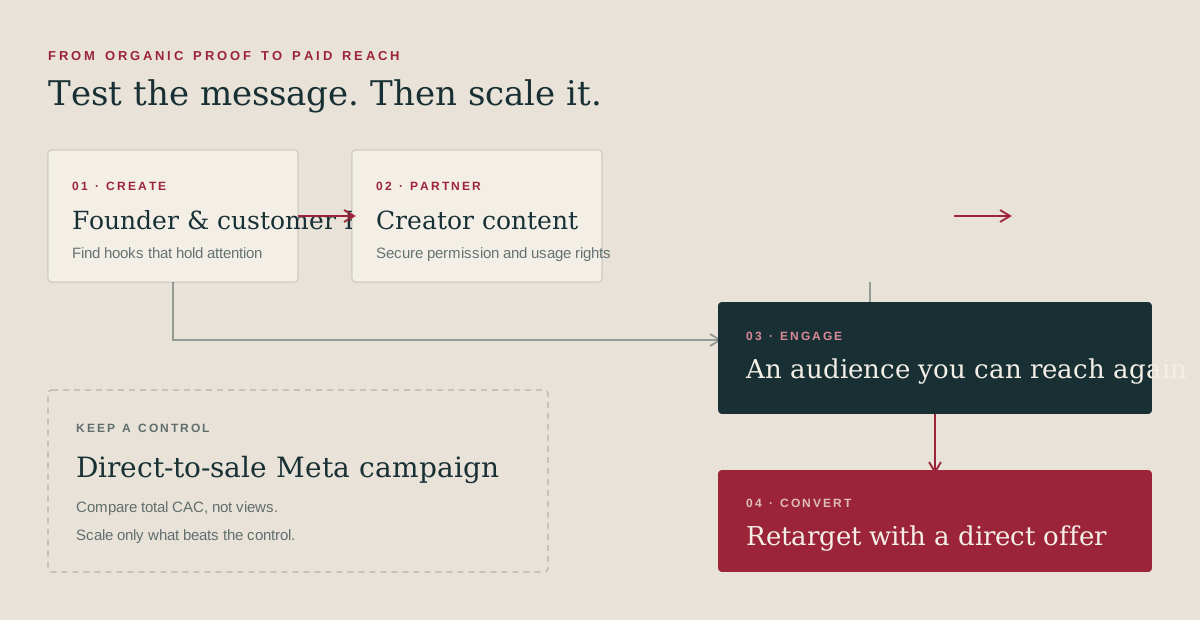
Organic Reels and partnership ads both build an audience of engaged viewers; retargeting turns them into buyers, and a direct-to-sale control shows whether the extra steps pay off.
How to measure results on a small marketing budget
Judge every method by total customer acquisition cost, not by views. Cheap views say nothing about whether the funnel is working.
Add up every cost that went into a campaign, then divide by the customers it produced:
Total customer acquisition cost
Total CAC = all campaign costs ÷ new customers
Content + creator fees + gifted product + shipping + ad spend
For example, ₹8,000 in creator fees, ₹4,000 in gifted product and shipping, and ₹18,000 in ads that bring 60 customers give a total CAC of ₹500. Compare that with your profit per customer, ideally over their lifetime.
Keep a control campaign. Run a simple direct-to-sale Meta campaign alongside your awareness work, with a similar budget. If the full funnel (organic content, then retargeting) does not beat the control on cost per customer, the extra awareness activity is not paying for itself yet.
When setting a marketing budget for a small business, give tests a fixed amount and a fixed end date. Scale only what beats the control.
A 30-day plan to test low-cost marketing strategies
Four weeks is enough to find one or two messages worth paying to scale.
- Week 1 · Learn the language
Answer 10 to 15 questions in niche communities. List the five problems that come up most and the exact words people use.
- Week 2 · Test hooks with Reels
Turn the top problems into 6 to 10 short Reels, using trial Reels where available. Change one thing at a time, such as the hook or the offer.
- Week 3 · Seed small creators
Send product to 5 to 10 well-matched nano or micro creators on affiliate or usage-rights terms. Ask two or three happy customers for short videos.
- Week 4 · Put money behind proof
Run your two best videos as Meta ads, using partnership ads for creator content. Retarget engaged viewers, keep a direct-to-sale control campaign, and compare total CAC.
At the end, keep what beat the control, drop what did not, and repeat with new hooks.
Frequently asked questions
What is the cheapest marketing strategy for a small business?
Organic short-form video made in-house and helpful answers in niche communities cost almost no cash. They still take time, so count your hours as a cost.
Is nano influencer marketing worth it for small brands?
Often, yes, as a test. Nano creators usually charge less and have close-knit audiences. Gifting does not guarantee a post, so use affiliate terms or clear agreements and measure sales, not reach.
What is the difference between micro influencer marketing and partnership ads?
Micro influencer marketing is the creator posting to their own followers. Partnership ads are paid ads that run the creator's post under their handle and your brand, with your targeting and budget, after the creator grants permission.
Can I retarget an influencer's audience on Meta?
Not simply by paying for their post. Engagement audiences come from content your own accounts publish or advertise. Running the creator's content as a partnership ad is the usual way to reach and then retarget viewers.
How much marketing budget does a small business need to start?
There is no fixed number. Set a test budget you can afford to lose, give it an end date, and scale only what beats a direct-to-sale control on total customer acquisition cost.
Start small, then scale what sells
The best low budget marketing ideas are the ones that teach you something before you spend. Start with founder and customer Reels, add a few tightly matched creators, then put Meta ad money behind the content that already works. Measure total acquisition cost against a control campaign, and you will know which low-cost marketing strategies deserve a bigger budget.
Sources
- Instagram: Trial reels
- 9to5Mac: Instagram's trial reels let creators test content with non-followers
- TechWyse: Meta turns creator partnerships into a faster paid media workflow
- Make Influence: Meta custom audiences from influencer content engagement
- FTC: Disclosures 101 for social media influencers
- Khaitan & Co: ASCI influencer advertising guidelines